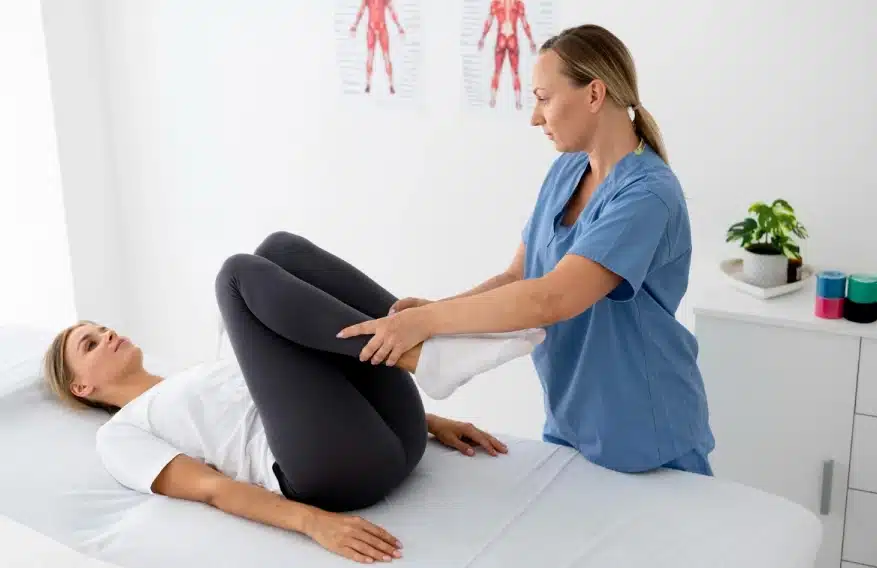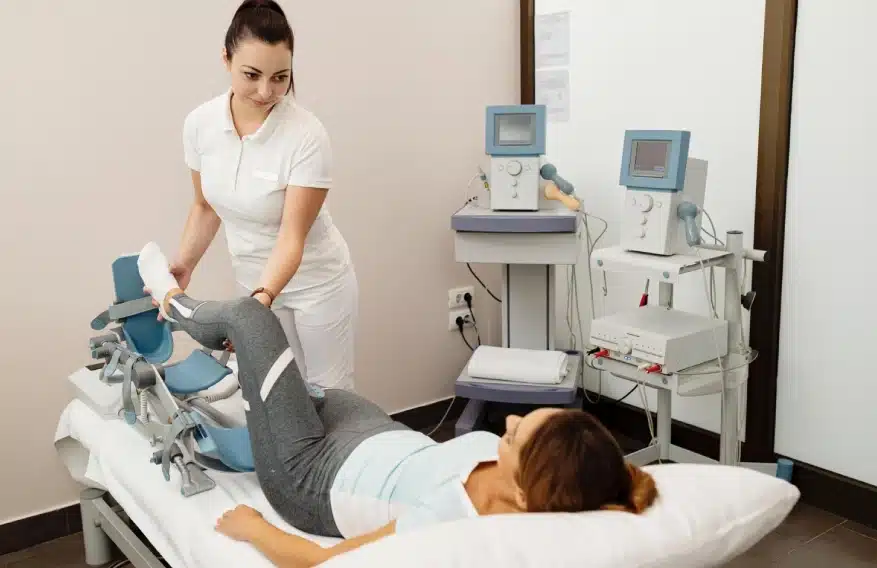
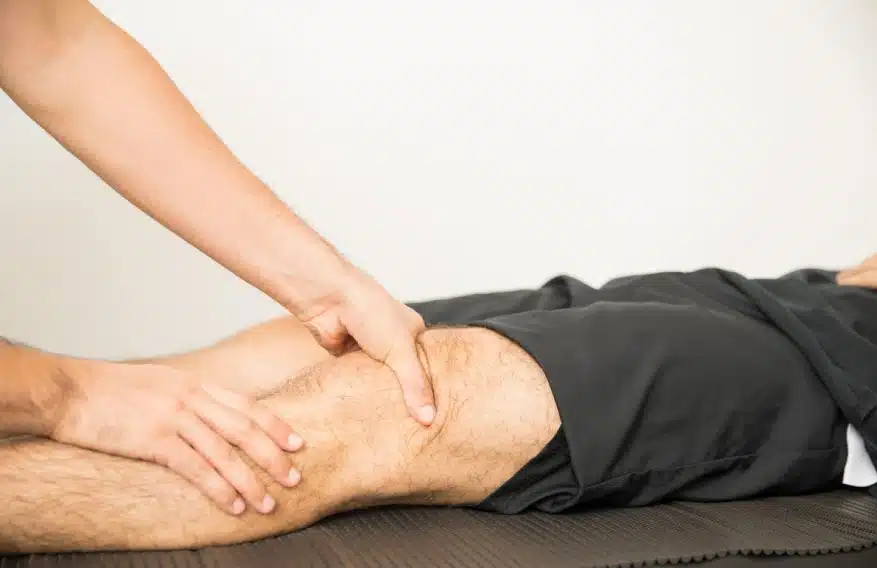
Knee replacement surgery is an important step, but the operation itself is only one part of recovery.
After surgery, people need to gradually regain movement, walking ability, strength and confidence in everyday activities. Physiotherapy can support this process by helping the patient progress from early mobilisation to more demanding functional tasks according to the surgeon’s instructions and individual recovery.
For people searching for knee replacement physiotherapy Dubai, it is important to understand that rehabilitation should not be based on promises such as “you will walk normally in two weeks” or “you will fully recover in six sessions”.
Recovery varies between individuals.
NHS guidance notes that recovery after knee replacement may take several months or longer and can differ according to factors such as general health and the type of replacement performed.
A better way to understand knee replacement rehabilitation Dubai is to look at stages and functional milestones rather than guaranteed dates.
This guide explains what physiotherapy may focus on during each stage, from the hospital period through walking, strength, stairs and a gradual return to everyday life.
Why Physiotherapy Matters After Knee Replacement
Knee replacement changes the joint, but patients still need to rebuild the physical abilities required to use that joint confidently.
Rehabilitation may address:
- Knee movement
- Lower-limb strength
- Walking
- Transfers
- Balance
- Swelling-related movement limitations
- Use of walking aids
- Stairs
- Everyday activities
NICE recommends that rehabilitation after primary elective knee replacement should begin on the day of surgery where possible, and no later than 24 hours afterwards. Early rehabilitation should include mobilisation, advice about activities of daily living and a home exercise programme.
Before hospital discharge, patients should also receive individual rehabilitation advice and information about their home programme. NICE recommends supervised outpatient rehabilitation when patients continue to have functional difficulties or self-directed rehabilitation is not meeting their goals.
The exact rehabilitation pathway should therefore depend on the individual rather than following one identical programme for everyone.
Stage 1: The Hospital and Early Mobilisation Phase
The earliest stage normally begins in hospital.
The immediate priorities are usually not heavy strengthening or demanding exercises. The focus is on beginning safe movement and preparing for basic daily tasks.
A physiotherapist may work with the patient on:
- Moving in and out of bed
- Sitting and standing
- Beginning to walk
- Using a walker, crutches or another prescribed aid
- Basic knee exercises
- Understanding the home exercise programme
AAOS guidance similarly describes early postoperative exercises and walking as part of knee-replacement recovery, with the programme supervised by the orthopaedic surgeon and physical therapist.
Walking Soon After Surgery
Walking usually begins with assistance.
This does not mean the patient should immediately try to walk independently.
The appropriate walking aid depends on:
- Balance
- Strength
- Pain
- Confidence
- Surgical instructions
- Previous mobility
- Ability to maintain a safe walking pattern
NHS guidance states that people commonly begin walking soon after surgery with support from nurses and physiotherapists and may initially need crutches or a walking frame.
Progressing away from an aid should be based on safety and walking quality rather than simply reaching a particular day after surgery.
Stage 2: Managing Swelling While Restoring Movement
Pain, bruising and swelling are common after knee replacement and can affect how easily the knee moves. Royal National Orthopaedic Hospital guidance notes that swelling can continue for an extended period after surgery even as recovery progresses.
During this stage, rehabilitation may focus on improving movement while respecting the healing surgical area.
Knee Extension
Being able to straighten the knee is important for walking and standing.
A physiotherapist may assess whether the patient can comfortably move towards full extension and prescribe exercises appropriate to the surgeon’s protocol.
Knee Flexion
Knee bending is required for:
- Sitting
- Getting out of chairs
- Stairs
- Dressing
- Entering and leaving a car
- Many everyday activities
Flexion should be progressed gradually rather than forced aggressively simply to reach a particular number.
Individual goals can differ according to the operation, previous mobility and surgeon’s instructions.
Swelling Management
The rehabilitation plan may include advice relating to:
- Appropriate movement
- Positioning
- Elevation where advised
- Prescribed exercises
- Ice where recommended by the surgical team
- Avoiding unnecessary prolonged inactivity
NHS guidance recommends following hospital advice, elevating the leg to help manage swelling and maintaining regular movement as instructed.
Significant or increasing swelling should not automatically be assumed to be a normal rehabilitation problem because swelling can also occur with complications.
Stage 3: Building a Safer Walking Pattern
Once basic mobility improves, physiotherapy after knee surgery increasingly focuses on the quality and independence of walking.
The goal is not merely to walk without crutches as quickly as possible.
A physiotherapist may observe:
- Step length
- Weight transfer
- Knee movement during walking
- Limping
- Balance
- Confidence
- Walking speed
- Use of an aid
Royal National Orthopaedic Hospital guidance advises continuing to use a walking aid while the knee remains sore and suggests that walking normally with an aid is preferable to abandoning the aid too early and developing a poor walking pattern.
When Can Walking Aids Be Reduced?
There should not be a universal date.
Progress may depend on whether the patient can:
- Walk safely
- Maintain balance
- Control the operated leg
- Avoid a significant limp
- Manage the required distance
- Follow the surgeon’s weight-bearing instructions
Some people progress quickly. Others need longer.
Previous walking difficulties, age, other joint conditions, neurological problems and complications can all affect progression.
Stage 4: Rebuilding Strength
Knee replacement rehabilitation involves more than regaining knee bending.
Strength is important for:
- Standing from a chair
- Walking
- Controlling the knee
- Climbing stairs
- Getting in and out of a vehicle
- Returning to everyday activities
A total knee replacement rehab programme may gradually include exercises targeting the muscles around the knee as well as other lower-limb muscles involved in movement.
AAOS recommends regular exercise to restore strength and mobility after total knee replacement, but emphasises that the exercise programme should be supervised and adapted by the physical therapist and orthopaedic surgeon.
Exercises may progress from relatively simple movements to more functional tasks as the patient demonstrates sufficient control.
The important principle is progressive loading, not trying to make each session as difficult as possible.
Pain, swelling and movement quality should be considered when deciding whether an exercise should be progressed.
Stage 5: Practising Transfers and Everyday Activities
The ability to perform exercises in a clinic does not automatically mean someone is ready to manage daily life independently.
This stage may include practising:
- Sit-to-stand transfers
- Bed mobility
- Toilet transfers
- Getting into and out of a car
- Moving around the home
- Carrying out selected household activities
AAOS lists functional abilities such as getting in and out of bed, using the bathroom, walking safely with an assistive device and completing prescribed exercises among factors considered around hospital discharge.
This functional approach is particularly relevant for people living alone or those with additional mobility difficulties.
A physiotherapist may also consider whether support from an occupational therapist, family member or caregiver is necessary.
Stage 6: Learning to Manage Stairs
Stairs are a major concern for many people following knee surgery.
Early stair practice is often taught before discharge when the person needs to use stairs at home. Royal Orthopaedic Hospital guidance describes stair training and independent walking with sticks or crutches as part of preparing patients to return home.
Later rehabilitation can focus on improving:
- Leg strength
- Balance
- Confidence
- Step control
- Ability to ascend and descend safely
The correct technique may change as recovery progresses.
Initially, a patient may need:
- A handrail
- Walking aids
- A step-to pattern
- Assistance
Later, the aim may be a more normal reciprocal stair pattern where appropriate.
Again, progression should be based on ability rather than an automatic post-operative date.
Stage 7: Returning to Everyday Activity
The later stages of knee surgery recovery physiotherapy become increasingly specific to the patient’s normal life.
For one person, the goal might be walking comfortably through a shopping centre.
For another, it may be:
- Returning to work
- Driving after medical clearance
- Managing household tasks
- Walking outdoors
- Travelling
- Returning to low-impact recreational activity
NHS guidance notes that return to work varies according to the type of work and individual recovery, while driving should only resume when the person is medically fit and able to control the vehicle safely.
The rehabilitation plan should therefore ask:
What does this patient actually need to return to?
A desk worker has different requirements from someone whose job involves stairs, prolonged standing or physical labour.
Stage 8: Moving From Rehabilitation to Long-Term Exercise
Recovery does not necessarily end when formal physiotherapy appointments finish.
Royal National Orthopaedic Hospital recommends gradually building rehabilitation exercises and continuing an appropriate programme over the longer term.
Later rehabilitation may focus on:
- Maintaining strength
- Walking endurance
- Functional mobility
- Balance
- Low-impact exercise
- Specific recreational goals
Patients considering higher-impact activities should discuss them with their orthopaedic surgeon and physiotherapist rather than assuming that every activity is appropriate after joint replacement.
Why Recovery Timelines Differ
No responsible provider of post-operative physiotherapy Dubai should guarantee that everyone reaches the same milestone at the same time.
Recovery may be influenced by:
- Pre-operative strength and mobility
- Age and general health
- Partial versus total knee replacement
- Other joint problems
- Surgical complications
- Pain control
- Swelling
- Wound healing
- Other medical conditions
- Confidence and fear of movement
- Consistency with rehabilitation
- Home support
- Individual functional goals
NHS guidance explicitly notes that recovery time varies between people.
For this reason, physiotherapy should use functional milestones alongside the surgical timeline.
What Can Delay Progress?
A slower rehabilitation phase does not automatically mean something has gone wrong.
Progress may temporarily be affected by:
Persistent Swelling
Swelling can limit movement and make exercise more difficult.
Pain
Poorly controlled pain may make walking and exercise harder. Pain management should be discussed with the surgical team rather than independently changing medication.
Reduced Strength
People who had limited mobility before surgery may need more time to rebuild strength.
Other Health Conditions
Hip problems, back problems, neurological conditions or problems with the opposite leg can affect rehabilitation.
Fear of Falling or Movement
Confidence can influence walking and functional activity.
Complications
Infection, blood clots and other surgical complications require medical management and can alter the rehabilitation pathway. AAOS notes that complications can prolong or limit recovery even though they are uncommon overall.
Red Flags After Knee Replacement
Physiotherapy is not the correct response to every new symptom.
Patients should receive clear instructions from their surgical team about who to contact and when.
Possible Infection
AAOS identifies warning signs including:
- Persistent fever
- Shaking chills
- Increasing redness, tenderness or swelling around the wound
- Wound drainage
- Increasing pain at rest or with activity
These symptoms require prompt medical or surgical review.
Possible Blood Clot
Warning signs can include:
- New calf or leg pain unrelated to the incision
- Tenderness or redness above or below the knee
- Increasing swelling of the calf, ankle or foot
These require medical assessment rather than simply adding massage, stretching or exercise.
Possible Pulmonary Embolism
A blood clot can rarely travel to the lungs.
AAOS identifies symptoms such as:
- Sudden shortness of breath
- Sudden chest pain
- Chest pain associated with coughing
These symptoms require urgent medical attention.
What Happens During a Post-Operative Physiotherapy Assessment?
Before progressing treatment, the physiotherapist may review:
- Surgical history
- Surgeon’s instructions
- Current pain and swelling
- Wound status within physiotherapy scope
- Knee movement
- Strength
- Walking
- Walking aid use
- Transfers
- Stairs
- Everyday functional limitations
- Patient goals
The treatment plan can then be adjusted according to the current stage rather than assuming every knee replacement patient should receive the same exercises.
FISIO’s current physiotherapy service describes a one-to-one assessment model based on movement, medical history and individual goals, while its orthopaedic service explicitly includes rehabilitation after joint surgery.
Physiotherapy at FISIO After Knee Replacement
FISIO provides physiotherapy and orthopaedic rehabilitation services in Dubai, including rehabilitation following joint surgery. Its current services include individual assessment and progressive rehabilitation exercise based on the patient’s presentation.
For someone recovering after knee replacement, the programme may therefore focus on relevant areas such as:
- Knee mobility
- Strength
- Walking
- Balance
- Transfers
- Functional exercises
- Gradual return to everyday activities
The actual treatment plan should remain consistent with the orthopaedic surgeon’s restrictions and the patient’s medical status.
Physiotherapy should complement surgical follow-up, not replace it.
Frequently Asked Questions
When Should Physiotherapy Start After Knee Replacement?
NICE recommends rehabilitation on the day of surgery where possible and no later than 24 hours after primary elective knee replacement. Later outpatient rehabilitation depends on individual needs and goals.
How Long Does Knee Replacement Physiotherapy Take?
There is no universal duration. Rehabilitation may continue for weeks or months depending on movement, strength, function, health and personal goals. Overall knee-replacement recovery can take several months or longer.
When Can I Stop Using Crutches or a Walker?
This should be decided according to safety, walking quality, strength and physiotherapist or surgeon guidance. Removing an aid too early may contribute to an abnormal walking pattern.
Is Swelling Normal After Knee Replacement?
Some swelling is common after surgery and can persist for an extended period. New, severe or increasing swelling—especially when accompanied by calf pain, redness or other concerning symptoms—requires medical assessment.
How Much Should My Knee Bend?
There is no single target appropriate to every stage or every patient. Range-of-motion goals should be discussed with the surgeon and physiotherapist based on the procedure and functional needs.
When Can I Use Stairs?
Many patients are taught a safe stair technique before hospital discharge if stairs are necessary at home. Progress to more normal stair use depends on strength, balance and control.
Can Physiotherapy Guarantee Full Recovery?
No. Outcomes depend on the operation, general health, complications, pre-operative function, rehabilitation and individual factors.
Can I Exercise on My Own?
Patients are commonly given a home exercise programme, but exercises should first be selected and explained by the rehabilitation team. NICE recommends ensuring patients understand their rehabilitation goals and prescribed exercises and have access to support when needed.
Recovery Should Be Based on Progress, Not Pressure
A successful total knee replacement rehab programme is not a race to achieve arbitrary milestones.
Early rehabilitation focuses on safe movement. The next stages build knee mobility, walking, strength, transfers and stairs. Later rehabilitation becomes increasingly focused on the activities that matter to the individual.
Some patients progress rapidly. Others need additional time or supervised rehabilitation.
The most important approach is to follow the surgeon’s instructions, monitor symptoms carefully and progress rehabilitation according to function rather than comparing recovery with another person.
Recovering from knee replacement surgery in Dubai? Book a physiotherapy assessment at FISIO to discuss your current mobility, surgeon’s instructions and rehabilitation goals.
Medical disclaimer: This article provides general educational information and does not replace individual medical, surgical or physiotherapy advice. Rehabilitation after knee replacement should follow the instructions of the treating orthopaedic surgeon and rehabilitation team. Seek urgent medical care for symptoms that may indicate infection, a blood clot, pulmonary embolism or another surgical complication.
Tags: